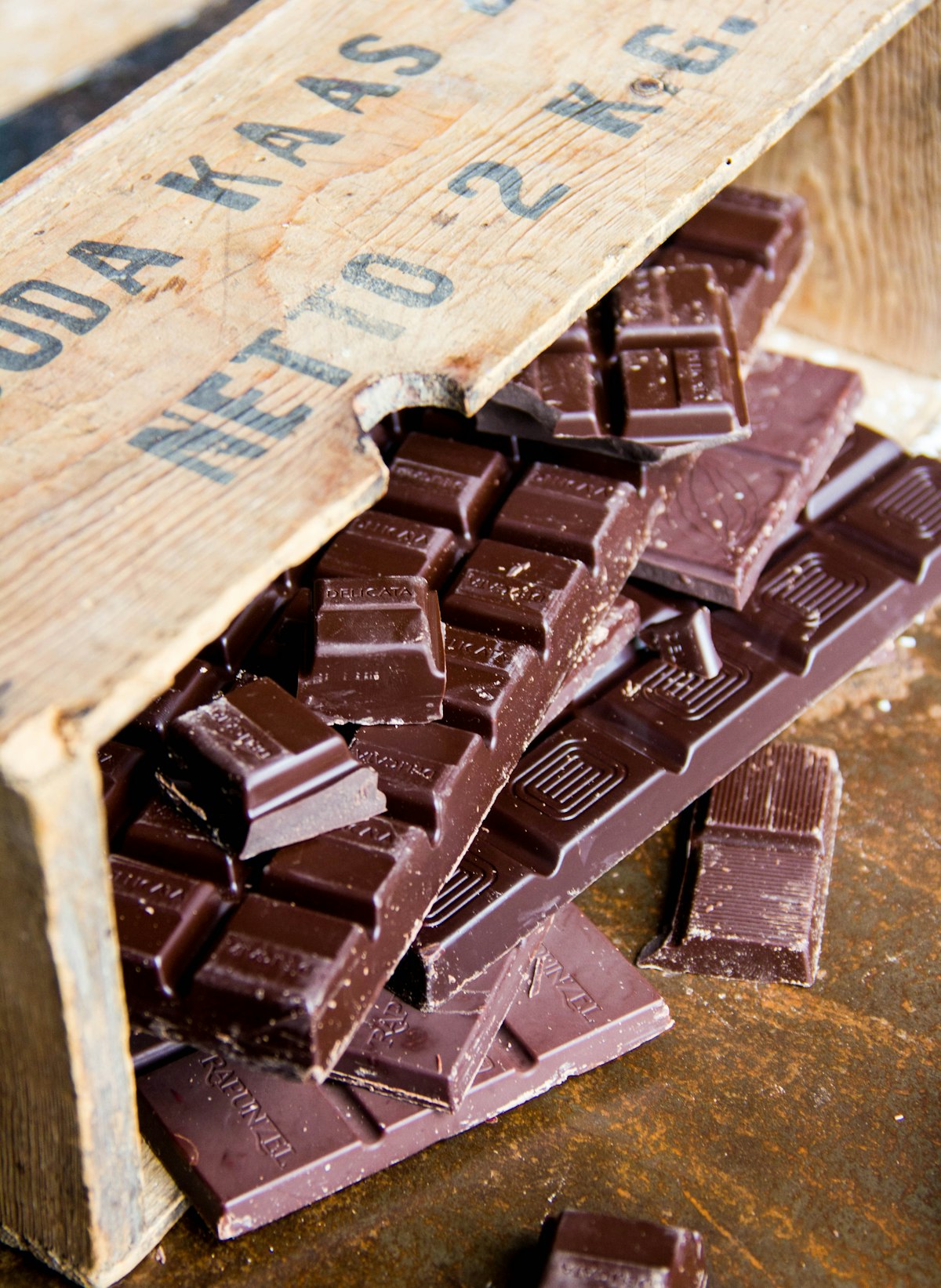
Snap a square of good dark chocolate in two and you get a clean crack, a glossy face, and a bar that sits solid in your hand yet melts the instant it touches your tongue. None of that is an accident. It's the visible signature of a single, carefully coaxed arrangement of fat molecules — and getting it wrong turns a luxury into a crumbly, dull disappointment.
Chocolate is mostly fat, and fat is fussy
A bar of chocolate is sugar, cocoa solids, and — crucially — cocoa butter, the natural fat pressed from the cacao bean. Cocoa butter can make up roughly a third or more of a fine dark chocolate by weight, and it's the part that actually sets. The cocoa solids give flavour and colour; the cocoa butter gives chocolate its body, its shine, and its mouthfeel.
Here's the catch. Cocoa butter is a fat that can solidify in more than one way. The same molecules can stack into several different crystal structures, and they don't all behave alike. This property has a name: polymorphism — "many forms."
Six ways to freeze the same fat
Chemists recognise six distinct crystal forms of cocoa butter, conventionally numbered with Roman numerals from I to VI. They differ in how tightly and neatly the fat molecules pack together, and — the key point — they melt at different temperatures.
- Forms I–IV are loosely or awkwardly packed. They form quickly when chocolate is simply poured and left to cool, but they're soft, low-melting, and unstable.
- Form V is the sweet spot: a dense, orderly, well-aligned crystal that's hard at room temperature, melts just below body heat, and gives a glossy surface and a crisp snap.
- Form VI is even more tightly packed and stable, but chocolate can't be set into it directly — it only creeps toward Form VI slowly, over weeks or months, after the bar is made.
So the entire craft of chocolate-making comes down to a deceptively narrow goal: persuade the cocoa butter to set almost entirely into Form V, and nothing else.
The “Aha!” Moment
The "quality" of a chocolate bar isn't only about better beans — it's about better crystals. The same cocoa butter, set carelessly, gives a dull, soft, crumbly bar; coaxed into Form V, it gives gloss, snap, and that clean melt. The chocolate hasn't changed chemically. Only the way its fat molecules are stacked has.
Tempering: teaching fat the right shape
The technique that delivers Form V is called tempering, and it's essentially a choreography of temperature. Done by hand or by machine, it follows the same logic:
- Melt fully. Heat the chocolate (typically into the high 40s°C / low 120s°F for dark chocolate) so every existing crystal dissolves. You start from a clean slate of liquid fat.
- Cool to seed. Bring it down (to roughly the high 20s°C / low 80s°F) so crystals begin to form. At this stage you get a mix of forms — including the stable Form V and the unwanted softer ones.
- Warm gently and hold. Raise it a few degrees (dark chocolate is worked around the low 30s°C / high 80s°F). This is the clever step: the temperature is warm enough to re-melt the unstable low-melting crystals but cool enough to leave the higher-melting Form V crystals intact.
What survives is a population of tiny Form V "seed" crystals dispersed through the liquid fat. As the chocolate finally cools and sets, those seeds act as templates: the rest of the cocoa butter crystallises onto them in the same orderly Form V pattern. Tempering, in other words, is selective survival followed by guided growth.
The Science Behind It
Different crystal forms melt at different temperatures because of how neatly the molecules pack. Tightly, regularly packed molecules attract one another more strongly and need more heat to pull apart — so they melt higher. Form V melts higher than the unstable forms but, conveniently, still below human body temperature. That single fact is why a tempered bar can be rock-solid in your hand and liquid on your tongue.
The body-temperature magic trick
This is the everyday wonder hiding in a chocolate bar. Cocoa butter is unusual among edible fats: it stays firm across normal room temperatures, then melts over a narrow range that happens to fall just under body temperature, around the low-to-mid 30s°C (low-to-mid 90s°F).
So a well-tempered bar holds its shape in your pocket on a mild day, resists smudging in your fingers — and then, the moment it reaches the warmth of your mouth, the whole structure collapses into smoothness almost at once. That swift, near-complete melt is what we register as "luxurious." It's not a flavour effect at all; it's a phase change timed beautifully to human physiology.
Bloom: when the crystals misbehave
Leave chocolate too warm, or set it badly, and you'll meet its failure mode: a dull, whitish, sometimes patchy film called bloom. It's harmless to eat but it ruins the look and feel — and there are two distinct kinds.
Fat bloom happens when the fat crystals migrate and recrystallise at the surface — often because the chocolate was poorly tempered, or got warm enough to let unstable crystals melt and re-form into coarse Form VI crystals over time. The surface roughens, scatters light, and goes matte instead of glossy. This is why a chocolate bar left in a hot car emerges grey and sad.
Sugar bloom is different: moisture (from condensation or a damp fridge) dissolves surface sugar, then evaporates and leaves sugar recrystallised as a gritty haze. Same dull look, entirely different cause.
Both are visible reminders that the gloss and snap you admire are a metastable achievement — a delicate arrangement that the chocolate would happily abandon if you let it warm up and drift toward its more stable, uglier state.
Try This at Home
Compare two bars: a quality dark chocolate stored cool, and a cheap one that's been left somewhere warm. Bend each. The well-tempered bar snaps with a sharp crack and a clean edge; the bloomed or untempered one bends, crumbles, or breaks dully. You're feeling the difference between Form V and a disorganised crystal mess — with your hands.
The crack you can trust
That snap, then, is more than a satisfying sound. It's a quality report. A clean break tells you the cocoa butter set into a dense, well-ordered Form V crystal lattice — that someone took the trouble to melt, cool, and reheat the chocolate through exactly the right temperatures so the fat would freeze in its best possible shape.
So the next time a square cracks crisply between your fingers and then melts away on your tongue, you'll know you're tasting a tiny triumph of physical chemistry: the same fat that could have been soft and dull, persuaded instead to stack into the one arrangement that's hard when you want it hard, and liquid exactly when you want it gone.