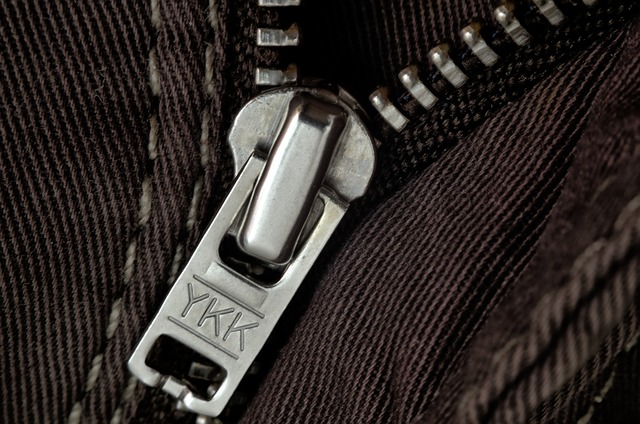
You probably operated one within minutes of getting dressed this morning, and you almost certainly didn't think about it. Yet the humble zipper is a small marvel of mechanical logic — a device that converts a single, lazy tug into dozens of precisely coupled latching events, then holds them shut against forces far greater than your fingers ever applied. Once you see how it actually works, you can't unsee it.
A row of tiny hooks, not a row of teeth
We call them "teeth," but that's misleading. Each metal or moulded element on a zipper tape is really a little hook-and-hollow: it has a raised bump (a nub) on one face and a matching dimple on the other. When two rows are brought together, the nub of each element on one side drops into the hollow of the element above and below it on the other side.
The result is an interlocked column where every element is gripped from two directions at once. Pull the two tapes straight apart sideways and they refuse to separate, because each nub is seated inside a pocket that physically blocks lateral motion. The load isn't carried by one weak joint — it's shared across the whole closed length, which is why a short zipper can restrain a surprisingly stubborn bag.
The slider is the clever part
The elements do the holding, but the slider does the thinking. Look inside one and you'll find a wedge-shaped plough and a set of internal channels arranged in a Y.
When you pull the slider up to close the zipper, the two separated rows of elements feed into the top arms of the Y. The narrowing channel forces them together at exactly the right angle and spacing so each nub seats into the hollow it's meant to find. They leave through the single bottom stem of the Y as one zipped column.
Pull the slider down and the geometry runs in reverse. The internal wedge drives between the two rows like a tiny ploughshare, levering each nub out of its hollow and splaying the rows back into the upper arms of the Y. Nothing is cut, bent, or worn — the slider simply guides elements into and out of a stable mechanical state.
The “Aha!” Moment
A zipper doesn't "stick together" along a seam — it's a chain of individual latches. The slider isn't fastening a join; it's a portable jig that performs the same precise coupling, element by element, as fast as your hand can move. One motion, dozens of identical mechanical events.
From a flop to a fortune: a short, slow history
The story begins with frustration over shoelaces. In 1893, the American inventor Whitcomb Judson patented a "clasp locker" — a row of hooks and eyes worked by a sliding guide. It was ingenious in spirit but unreliable in practice: it popped open, jammed, and was fiddly to manufacture. The buying public was unimpressed.
The breakthrough came from a Swedish-American engineer named Gideon Sundback, who joined the company carrying Judson's idea forward. Around 1913–14 he abandoned the hook-and-eye approach entirely and devised the interlocking-element design we still use today — identical nub-and-hollow teeth on a fabric tape, fed together by a slider. He also built the machinery to mass-produce it accurately, which mattered just as much as the design itself.
The word "zipper" came later still — coined in the 1920s by a galoshes maker for the satisfying zip sound the fastener made. The name stuck to the device, not the boots.
Why it almost never fails
A well-made zipper is quietly over-engineered. Because the closing force is distributed across many interlocked elements, no single point bears the full strain. Each element is also held in two axes at once, so ordinary tugging can't peel the rows apart the way it could a simple seam of hooks.
When zippers do fail, it's rarely the elements that give out. The usual culprits are:
- A worn slider. Its channels widen with use until it no longer presses elements firmly enough to seat them — so the zip closes but gaps open behind it.
- Fabric in the throat. A thread or lining caught in the Y-channel blocks the slider's path.
- A bent or missing element. One damaged tooth breaks the chain, and the latch fails at that link.
Notice that the first failure mode explains a maddening everyday experience: a zipper that "won't stay done up." The teeth are fine — the slider has simply worn loose, and gently crimping it back can often restore the grip.
The physics of the stuck zipper
Why does a jammed zipper resist so fiercely, and why does forcing it usually make things worse? Blame stored energy and friction. When fabric wedges into the slider, you're no longer just guiding elements — you're trying to drag cloth through a narrowing metal channel. The harder you pull, the tighter the wedge bites, increasing the friction that's blocking you. It's a self-reinforcing trap.
The fix is counter-intuitive but mechanically sound: reverse the slider a little to relieve the pinch, then ease the trapped fabric out. A touch of lubricant — graphite from a pencil tip, a bar of soap, lip balm — lowers the friction in the channels enough for the slider to glide again. You're not fixing the elements; you're restoring the slider's ability to do its job.
Try This at Home
Take a zip you don't mind sacrificing and close it halfway. Now look straight down into the open end of the slider. You'll see the Y: two channels going in, one coming out. Rub a graphite pencil along the closed teeth, then work the slider — it should run noticeably smoother. That graphite is a dry lubricant doing exactly what oil would, without staining the fabric.
Why a Victorian idea still wins
Today one manufacturer, Japan's YKK, makes a vast share of the world's zippers, controlling everything from the brass alloy to the machines that cut the teeth — obsessive consistency being the whole point of a device with so many identical parts.
And despite a century of alternatives, the zipper endures. Hook-and-loop tape (Velcro) is quick but bulky, noisy, and lint-clogging. Magnetic and snap closures are elegant on light loads but can't hold a continuous high-tension seam. Buttons are charming and slow. The zipper alone offers a strong, fully sealed, reusable closure that opens in a single stroke and packs almost flat — a combination nothing has bettered.
That's the quiet genius of it. A zipper turns a one-dimensional gesture into a row of self-locking joints, distributes the load so nothing strains, and lets you reverse the whole thing on a whim. The next time you hear that little zip, remember it's the sound of dozens of tiny hooks finding their hollows in perfect sequence — a 19th-century insight so good we've simply never needed to replace it.