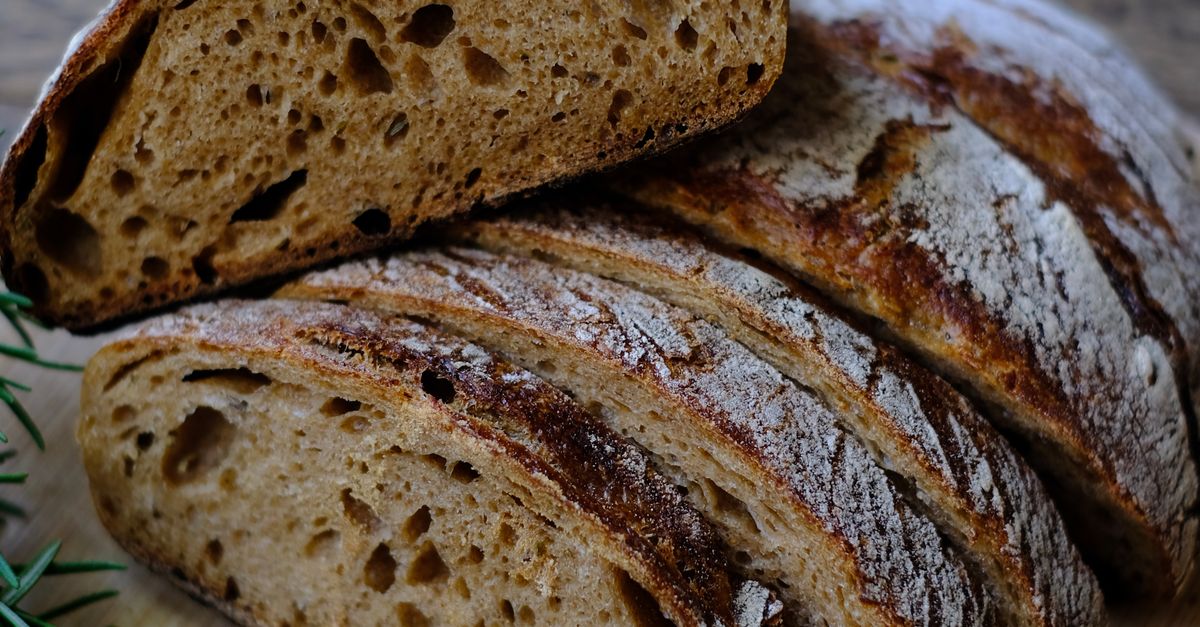
Leave a loaf out overnight and by morning it has turned tough, crumbly and faintly disappointing. The obvious explanation is that it dried out. The obvious explanation is wrong. Stale bread is, for the most part, not bread that has lost its water — it is bread whose water has quietly rearranged itself. The proof is sitting in your freezer.
To understand why your toast goes hard, you have to look past the loaf and into the starch granules that make up most of its crumb. What happens to them as bread cools is one of the tidiest pieces of hidden chemistry in the kitchen.
Fresh bread is a structure held in suspense
Flour is mostly starch, and starch comes in two molecules: amylose, a long straight chain of glucose units, and amylopectin, a sprawling, heavily branched one. In raw flour these molecules are packed into dense, semi-crystalline granules.
When you add water and apply heat, those granules swell and burst. The starch molecules unwind and spread out, soaking up water and trapping it in a soft, open, gel-like network. This process is called gelatinisation, and it is what turns a stiff dough into a tender, springy crumb.
Here is the key point: fresh bread is not in a stable state. The starch has been forced into a loose, disordered arrangement by heat. As the loaf cools, the molecules begin doing what molecules tend to do when left alone — settling back toward order.
Staling is starch slowly recrystallising
The technical name for what happens next is retrogradation. As bread cools and sits, the starch molecules gradually re-associate and form crystalline regions again. The straight amylose chains firm up quickly, within hours, giving fresh-baked bread its initial set. But the slow, ongoing staling over the following days is driven mainly by the branched amylopectin recrystallising bit by bit.
As these crystalline regions form, they squeeze water out of the flexible starch network and lock the structure into a more rigid form. The crumb stiffens. It is no longer the molecules holding water loosely in an open gel — it is starch pulling itself into tighter, harder order.
The “Aha!” Moment
Stale bread hasn't necessarily lost much water at all. The water has simply migrated — out of the starch crystals that are forming, and often outward through the loaf. The crumb feels dry because its structure has hardened, not because it has dehydrated. Staling is reorganisation, not evaporation.
Why the moisture moves the wrong way
In a fresh loaf, the crumb is moist and the crust is dry and crisp. Over time that gradient reverses. Water released by the recrystallising starch, plus moisture migrating from the wet interior, travels outward to the crust. That is why day-old bread has a leathery, soft crust and a firm, dry-feeling interior — exactly the opposite of fresh.
This is also why wrapping warm bread tightly in plastic ruins the crust: you trap the escaping moisture against it. And it is why a loaf in a paper bag keeps a better crust but stales a touch faster — the paper lets water escape entirely.
The fridge trap and the freezer rescue
Now the part that catches almost everyone out. Retrogradation does not happen at a constant rate — it has a temperature sweet spot. Recrystallisation proceeds fastest at cool-but-not-freezing temperatures, roughly the temperature inside your refrigerator.
So putting bread in the fridge is one of the worst things you can do. You are parking it precisely in the zone where starch recrystallises most efficiently. Refrigerated bread can go stale several times faster than bread left on the counter.
The freezer does the opposite. Below freezing, the water is locked into ice and the starch molecules can barely move. Retrogradation effectively stops in its tracks. Freezing doesn't reverse staling, but it presses pause — which is why a frozen-then-thawed loaf can taste startlingly fresh.
The Science Behind It
Staling is a kinetic process: it needs molecular mobility to proceed. Fridge temperatures keep the starch molecules mobile enough to rearrange, while being cold enough to speed the drive toward crystalline order — the worst of both worlds. Freezer temperatures remove the mobility entirely, halting the reaction. Counter temperature sits in between.
Why warming brings bread back
If staling is recrystallisation, then undoing it should be possible — and it is. Heat the stale bread above roughly 60°C (140°F) and the amylopectin crystals melt back apart, the starch network loosens, and the trapped water becomes mobile again. This is why a stale slice in a hot oven, or a loaf briefly warmed through, tastes remarkably revived.
The catch is that the rescue is temporary. As the bread cools again, the starch immediately begins recrystallising — often faster than the first time, because some structure persists. A twice-warmed loaf goes hard again quickly. This is why a microwaved roll feels lovely for thirty seconds and turns to a tough little brick a minute later: you melted the crystals, then let them snap straight back.
What to actually do with your bread
- Eat it fresh, or freeze it. There is no useful middle ground for storage longer than a day or two.
- Never refrigerate bread unless you are specifically fighting mould in a hot, humid climate — and accept it will stale faster.
- Freeze it sliced so you can revive single pieces straight from frozen in the toaster.
- Warm stale bread to refresh it, but eat it promptly — the clock restarts the moment it cools.
None of this is about keeping water in the loaf. It is about keeping the starch in the disordered, suspended state that baking created. Bread is delicious precisely because it is not at rest — and staling is simply the long, quiet process of it finally settling down.