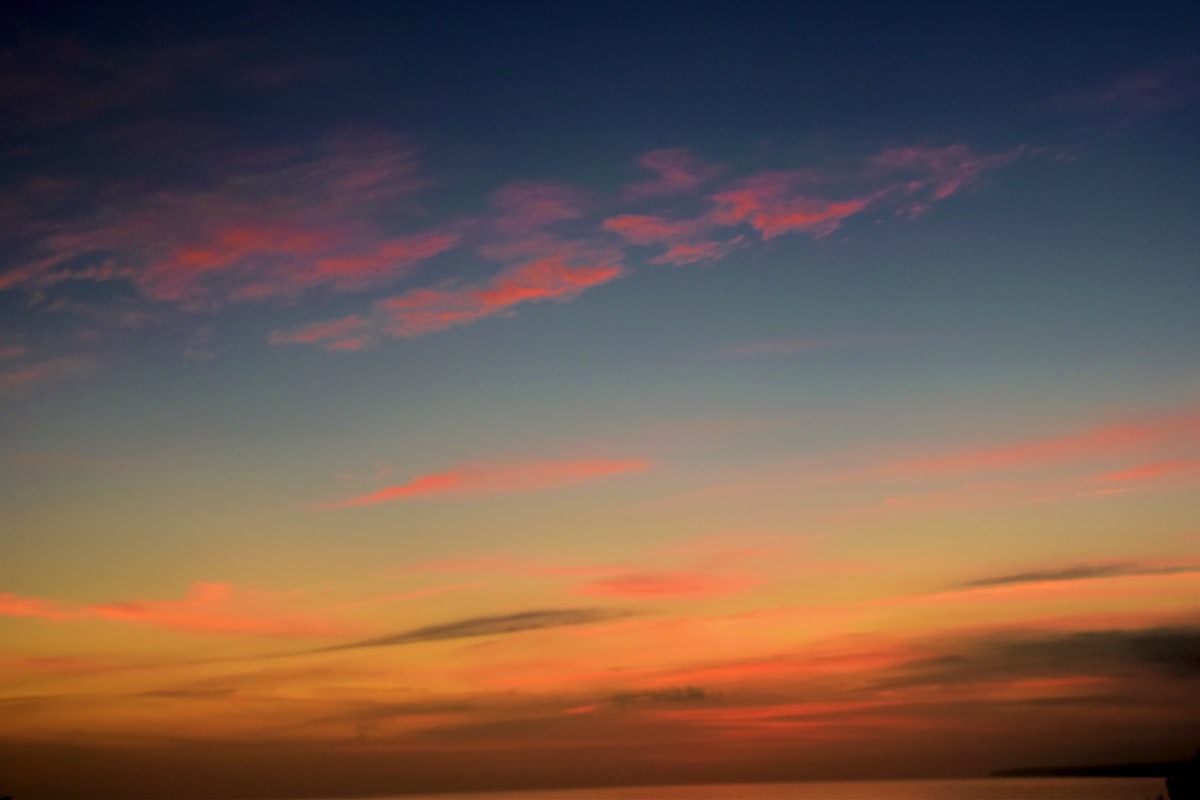
Stand outside at noon and the sky is a flat, confident blue. Wait a few hours and the same patch of air over your head will catch fire — gold, then orange, then a deep arterial red. Nothing about the air itself has changed. What changed is the journey the sunlight had to make to reach your eyes.
The whole spectacle comes down to a single, slightly counter-intuitive fact: sunlight does not travel through the atmosphere untouched. It collides with the air, and different colours get knocked off course by different amounts. Once you understand which colours get scattered and why, the daytime blue and the evening red stop being two separate mysteries and become two views of the same simple process.
Sunlight Is a Bundle of Colours
What we call "white" sunlight is really a mixture of every colour, from violet and blue at the short-wavelength end through green and yellow to orange and red at the long-wavelength end. A prism — or a raindrop — can fan that bundle out into a rainbow, but normally all the colours arrive together and our eyes read the blend as white.
Crucially, those colours behave like waves of different sizes. Blue and violet are short, tightly packed waves. Red is a longer, lazier wave. When light meets the molecules of nitrogen and oxygen that make up most of the air, the size of the wave decides how badly it gets thrown around.
Why the Midday Sky Is Blue
The molecules in our atmosphere are far smaller than the wavelength of visible light. When light waves run into particles this tiny, the effect is called Rayleigh scattering — named after the nineteenth-century physicist Lord Rayleigh, who worked out the mathematics.
The headline result of his work is striking: the amount of scattering depends very steeply on wavelength. Shorter waves are scattered enormously more than longer ones. Blue light gets bounced in all directions perhaps ten times more readily than red light. So when sunlight pours down through the air at midday, the blue portion is constantly being knocked sideways, ricocheting from molecule to molecule and spilling out across the whole dome of the sky.
That scattered blue light reaches your eyes from every direction at once, which is why the sky glows blue rather than appearing black with a single bright sun. (Violet is scattered even more strongly than blue, but there is less violet in sunlight and our eyes are less sensitive to it, so blue wins.)
The Science Behind It
Rayleigh scattering is roughly proportional to one over the wavelength to the fourth power. Halve the wavelength and the scattering jumps by a factor of sixteen. That brutal arithmetic is why the short, blue end of the spectrum dominates the daytime sky while the long, red end mostly carries straight on through the air.
Why Sunsets Turn Red
Now follow the same light at the end of the day. When the Sun sits low on the horizon, its rays no longer plunge straight down through the thinnest slice of atmosphere. Instead they skim in at a shallow angle, ploughing through a far longer column of air — many times the thickness they pass through at noon.
Over that long path, almost all the blue light gets scattered away sideways long before it can reach you. What survives the journey to your eyes is the light that scatters least: the oranges and reds at the long-wavelength end. The Sun itself reddens, and the clouds and sky around it pick up the same warm tones. The blue has not vanished from the universe — it has simply been scattered out of your particular line of sight and is busy lighting up the sky for someone a few hundred kilometres to your west.
Why Evening Differs from Midday
So the single variable that flips the sky from blue to red is path length — how much air the light must cross to reach you.
- At midday the Sun is high, the path through the atmosphere is short, only blue is efficiently scattered, and the overhead sky glows blue while the Sun stays near-white.
- At sunset and sunrise the Sun is low, the path is long, the blue is filtered out along the way, and only the reds and oranges complete the trip.
It is the same air and the same sunlight at both times of day. The geometry of the journey is all that has changed.
The Role of Dust, Smoke and Humidity
Pure air molecules give you the basic blue-to-red story, but the atmosphere is rarely pure. Dust, sea salt, smoke, pollution and droplets of water add larger particles, and these scatter light differently — often nudging more colours sideways at once and adding a milky or hazy quality.
This is why the most flamboyant sunsets often follow dust storms, wildfires or volcanic eruptions: extra particles in the upper air act on the already-reddened light, intensifying and spreading the colour. Humidity and haze can do the opposite to the daytime sky, washing the deep blue toward a paler, whiter tone because the larger water-laden particles scatter all wavelengths more evenly. The cleanest, deepest blues belong to high, dry places where there is little but pure air between you and space.
The “Aha!” Moment
You are never really seeing the colour of the sky — you are seeing the colour of light that has been bounced toward your eyes by the air, and the colour of the Sun is whatever managed to survive the trip. Blue noon and red sunset are not two different skies. They are the same beam of sunlight, scattered more or less depending only on how far it had to travel through the air to find you.
The next time the evening goes gold, you can read it like a measurement. The deeper the red, the longer the road that light has just travelled — and the more blue it spilled across the sky on the way to your eyes.