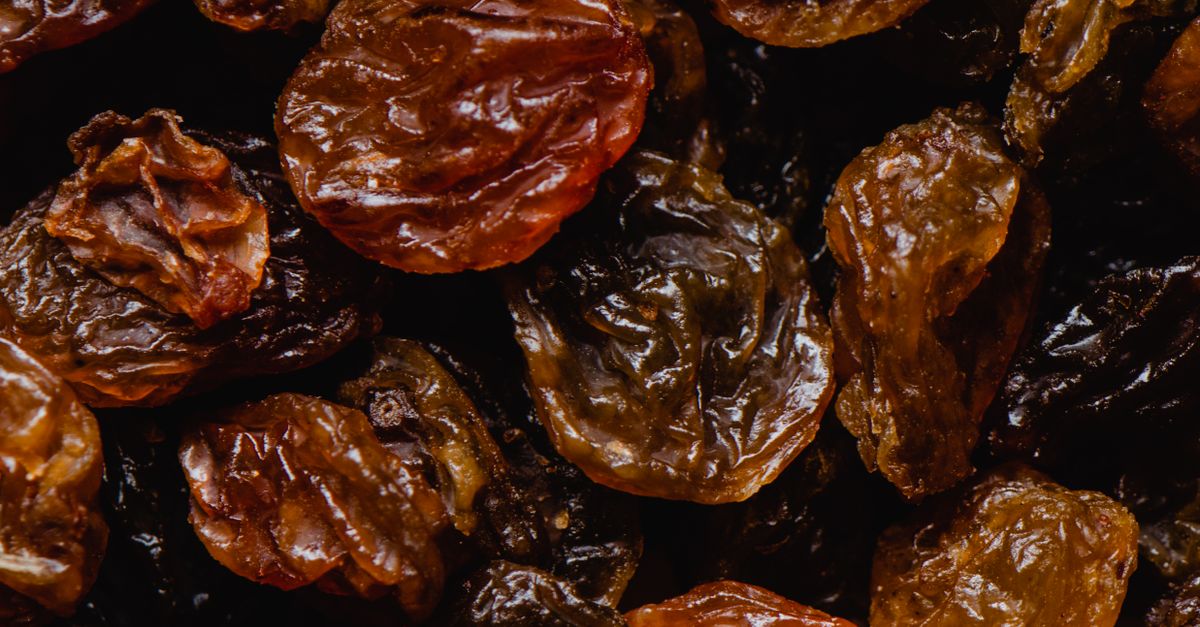
Drop a handful of raisins into a glass of fizzy water and something faintly absurd happens: the raisins begin to bob up and down, rising to the surface, pausing, then tumbling back to the bottom — over and over, like a tiny, wrinkled corps de ballet. There's no trick, no hidden motor, no static charge. Just dissolved gas, a rough surface, and two of the most reliable rules in physics quietly doing their job in your kitchen.
This is one of those experiments that rewards a second look. The first watch is delightful. The second is where the "aha" lives — because once you understand why the raisins dance, you start seeing the same logic in submarines, in fish, and in the glass of soda sweating on your counter.
What you'll need
Everything here is likely already in your home. The whole setup takes about two minutes.
- A tall, clear glass — a drinking glass or jar works perfectly. The taller and clearer, the better the view.
- Fresh carbonated water or a clear fizzy drink — plain sparkling water, soda water, or a clear lemon-lime soda. The key word is fresh: a newly opened bottle holds far more dissolved gas than a flat, half-empty one.
- A small handful of raisins — ordinary dried raisins, the more wrinkled the better. Sultanas work too.
That's it. No measuring, no mess, nothing to dispose of carefully afterwards.
How to make raisins dance
Follow these steps and you'll have your dancers moving within seconds.
- Fill the glass nearly to the top with fresh carbonated water. Do this gently — you want to keep as much fizz in the liquid as possible.
- Drop in five or six raisins. They'll sink straight to the bottom at first. This is your starting clue: raisins are denser than water, so on their own they have no reason to float.
- Watch closely. Within ten to thirty seconds, tiny bubbles begin clinging to each raisin. One by one, the raisins lift off the bottom, rise to the surface, give a little shudder, and sink again.
- Keep watching. A single glass can keep dancing for many minutes, gradually slowing as the drink loses its fizz.
Try This at Home
Line up three glasses: one with fresh sparkling water, one with the same water left open and stirred until flat, and one with plain tap water. Add raisins to all three. Only the fresh, fizzy glass will dance — proof, in real time, that the gas is doing the lifting. For a bonus round, drop a smooth glass marble or a dried bean into the fizzy glass alongside the raisins and notice how poorly it dances by comparison. The surface matters as much as the fizz.
So what's actually going on?
Carbonated drinks are packed with carbon dioxide gas that has been forced to dissolve into the liquid under pressure. When you open the bottle, the pressure drops and that gas wants out — which is why the drink fizzes. The bubbles you see are CO₂ escaping back into the air.
But bubbles don't form just anywhere. They need a starting point — a tiny imperfection, a scratch, a rough patch — where gas molecules can gather and grow. Scientists call these spots nucleation sites. A raisin, with its deeply wrinkled, pitted surface, is covered in them. It's practically a bubble factory.
As CO₂ bubbles cling to the raisin's folds, they act like miniature life jackets. Here's the crucial part: a raisin by itself is denser than the water, so it sinks. But the raisin-plus-bubbles combination takes up more space while weighing almost nothing extra — the gas inside the bubbles is incredibly light. That extra volume displaces more liquid, and once enough bubbles attach, the whole bundle becomes less dense than the water around it. Up it goes.
The Science Behind It
This is Archimedes' principle in action: any object in a fluid is pushed upward by a buoyant force equal to the weight of the fluid it displaces. A bare raisin displaces only a little water, and that buoyant push is smaller than its own weight — so it sinks. Add bubbles, and the raisin displaces far more water without gaining meaningful weight. When the buoyant force finally exceeds the raisin's weight, it rises. At the surface, the bubbles burst into the open air, the displaced volume vanishes, buoyancy collapses, and gravity wins again. Down it sinks — until fresh bubbles rebuild the cycle. The dance is simply density flipping back and forth, over and over.
Why raisins, and not just anything?
The experiment hinges on two properties working together, and that's why a raisin is close to ideal.
First, it must be denser than water — otherwise it would simply float from the start and never sink, so there'd be nothing to lift. A raisin sinks on its own, which gives the cycle a bottom to return to.
Second, it needs a rough, textured surface so bubbles can grab hold. This is why a smooth, dense object — a glass bead, a clean coin, a marble — refuses to dance properly. It may be heavy enough to sink, but its slick surface offers nowhere for bubbles to nucleate, so it never gathers enough lift. Density gets the object to the bottom; texture is what brings it back up. You need both.
Variations to try
Once you've seen raisins perform, raid the cupboard and test the idea against other small, dense, textured items.
- Dried pasta — small shapes like little stars or broken spaghetti often bob nicely, and their ridges make good nucleation sites.
- Uncooked rice — grains are tiny but many will hop about, especially in very fresh fizz.
- Fresh blueberries or dried cranberries — their dimpled skins catch bubbles well, though heavier fruit may need a livelier drink.
- Lentils, peppercorns, or a piece of dried fruit — each behaves a little differently depending on its density and how rough it is. Predicting which will dance best is half the fun.
The same logic, scaled up
What looks like a kitchen novelty is exactly how some serious machines and living creatures manage to hover in water.
A submarine rises and dives using ballast tanks. To sink, it floods the tanks with water, increasing its overall density. To surface, it blows the water out with compressed air, replacing heavy water with light gas — making the sub less dense than the sea, just as bubbles make a raisin less dense than soda. It's the dancing raisin, built from steel.
Many fish do the same thing biologically. A swim bladder is a gas-filled sac inside the body; by adding or releasing gas, a fish fine-tunes its density to hover effortlessly at a chosen depth, neither rising nor sinking. Same principle, wrapped in scales.
And the humble glass of soda holds the headline act itself: all that fizz is carbon dioxide that was dissolved under pressure and is now escaping. The next time a soft drink goes flat, you're watching the very supply of gas that powers the dance simply running out.
So the next time you pour a sparkling water, drop in a raisin and watch for a moment. What you're seeing isn't a curiosity at all — it's buoyancy, density, and a few stray bubbles rehearsing the same physics that keeps submarines and salmon exactly where they want to be.